
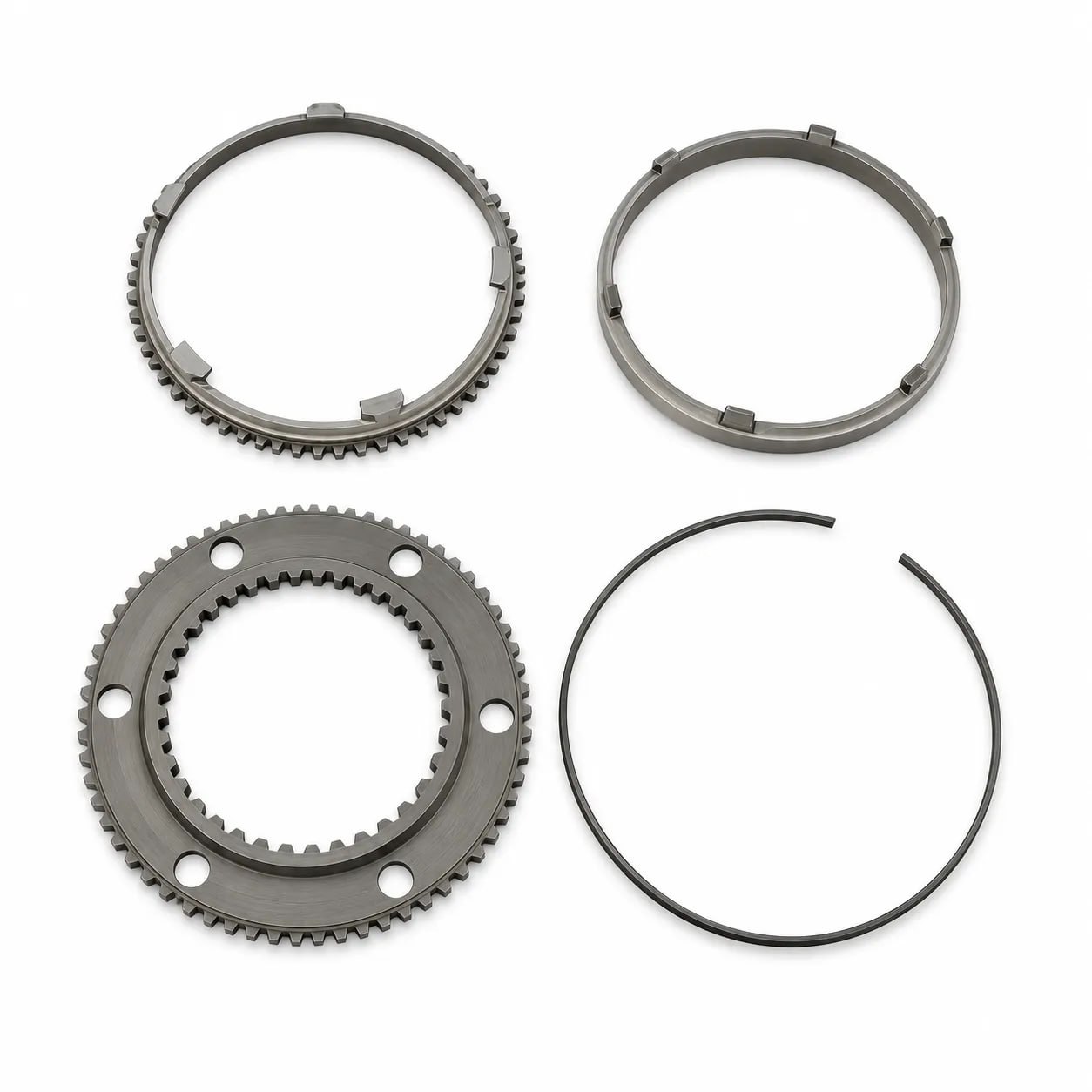
Short answer: a synchronizer RFQ should ask for a set, not a single ring. The ring, cone, hub, sleeve and small parts work together; a quote that ignores the mating surfaces is incomplete even when the reference is correct.
Why synchronizer RFQs fail
The common failure is a one-line request for a ring without the assembly, the coating or the mating parts. The supplier can quote a ring, but cannot confirm whether it is the right set for the rebuild.
Ask for the set
State which parts are being replaced and which are being inspected. If only the ring is worn, say so; if the cone or sleeve is also worn, include them.
| Component | Include in the RFQ |
|---|---|
| Ring | Reference, coating, friction face photo |
| Cone | Reference, surface condition, mating ring |
| Hub | Spline and key-slot condition, reference |
| Sleeve | Engagement teeth, fork groove, reference |
| Kit | Contents list and whether small parts are included |
Reference, coating and kit contents
A base number is not enough. The suffix can indicate a molybdenum-sprayed or carbon-coated face, or a complete assembly. For a kit, ask what is inside the exact reference; “synchronizer kit” is not a standard contents list. Link the synchronizer buyer’s guide when the buyer needs the component explanation.
Photos and measurements
Photograph the friction face, the cone surface, the hub splines and the sleeve teeth. Include the assembly nameplate and the stamped reference. Measure only what the supplier asks for; do not substitute a measurement for a reference check.
A copy-ready RFQ line
Use one line per component and keep the assembly header at the top.
| Field | What to write |
|---|---|
| Assembly | Transmission model and nameplate photo |
| Component | Ring / cone / hub / sleeve / kit |
| Reference | Full reference including suffix |
| Variant | Coating, tooth count or kit contents |
| Quantity | Units and repeat-order forecast |
| Destination | Country and packing requirement |
Confirm before the PO
Before ordering, confirm the reference, the coating, the kit contents and what is explicitly not included. The synchronizer catalogue and sliding sleeves and shift forks pages are the component entry points.
A step-by-step synchronizer RFQ
A synchronizer enquiry should identify the assembly, the component set and the evidence for each part. Work through the steps before sending a price request.
- Record the transmission model and nameplate.
- List the ring, cone, hub, sleeve and any kit on separate lines.
- Add the reference and suffix for each line.
- State the coating or friction face where known.
- Attach photos of the friction face, cone, splines and sleeve teeth.
- Ask the supplier to confirm kit contents and exclusions.
The component set and what to confirm
The ring is only one contact in the synchronizer. A quote that ignores the mating surfaces can be correct on paper and incomplete for the repair.
| Component | Confirm in the RFQ |
|---|---|
| Ring | Reference, coating, friction face |
| Cone | Reference, surface condition, mating ring |
| Hub | Spline and key-slot condition |
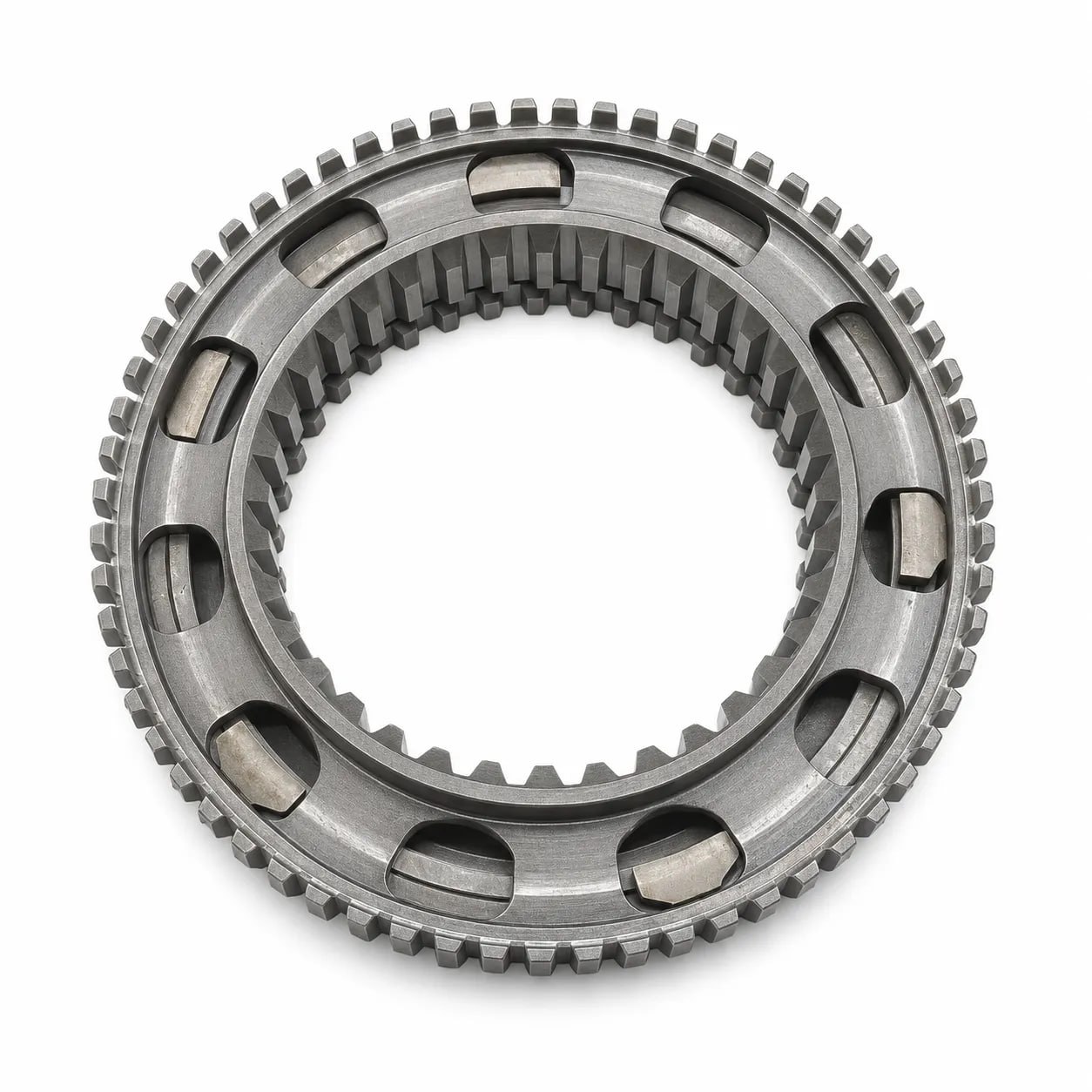
| Sleeve | Engagement teeth and fork groove |
| Kit | Contents list and small parts |
Coating, suffix and kit contents
A base number is not enough. A suffix can indicate a molybdenum-sprayed or carbon-coated face, or a complete assembly. For a kit, ask what is inside the exact reference; the category name is not a contents list.
If the buyer needs the component explanation first, link them to the synchronizer buyer’s guide. This page is the RFQ step, not a duplicate of that guide.
Photos and measurements to include
The photo set should let the supplier see the wear and the identity features without asking for another angle.
- Transmission nameplate and assembly model.
- Ring friction face, straight on.
- Cone surface and any wear step.
- Hub splines and key slots.
- Sleeve engagement teeth and fork groove.
- Stamped reference on each part.
Common synchronizer RFQ errors
These errors create a quote that looks complete but leaves the rebuild exposed.
- Requesting a ring only without checking the cone and sleeve.
- Omitting the coating or suffix.
- Assuming a kit includes springs, keys or retainers.
- Using a photo of a different variant as the only reference.
- Asking for “the same as the old one” without a stamped number.
Confirm before the PO
Before ordering, confirm the reference, the friction face, the kit contents and what is explicitly not included. The synchronizer catalogue and sliding sleeves and shift forks pages are the component entry points.
What to confirm on the kit reference
A kit reference can hide a different contents list. Ask whether the kit contains the ring, cone, hub, sleeve, keys, struts, springs and retainers, and ask what is deliberately excluded.
If the supplier cannot provide a contents list for the exact reference, treat the kit as unconfirmed. Do not assume the category name describes the contents. The same caution applies to a coating or friction-face variant.
- Exact kit reference and suffix.
- Contents list, including small parts.
- Coating or friction-face variant.
- What is not included.
- Whether the kit is matched to the assembly or the family.
Confirm the assembly before the components
The synchronizer set only makes sense against the assembly. Confirm the transmission model, the build and the nameplate before discussing the ring or kit. A correct component reference on the wrong build is still a wrong part.
If the assembly is not confirmed, mark the component lines as provisional. That prevents a quote from looking more certain than the evidence allows.
- Assembly model and nameplate photo.
- Build or ratio information if available.
- Component position and mating parts.
- What is confirmed and what is provisional.
Bottom line
A synchronizer RFQ is a set enquiry. Confirm the assembly, the reference and suffix, the friction face and the kit contents, then attach photos of the mating surfaces. A ring-only quote may be correct on paper but incomplete for the rebuild.
Need a reference checked? Send the assembly details, the stamped reference and photos of the old part. We confirm what the reference covers before quoting.