
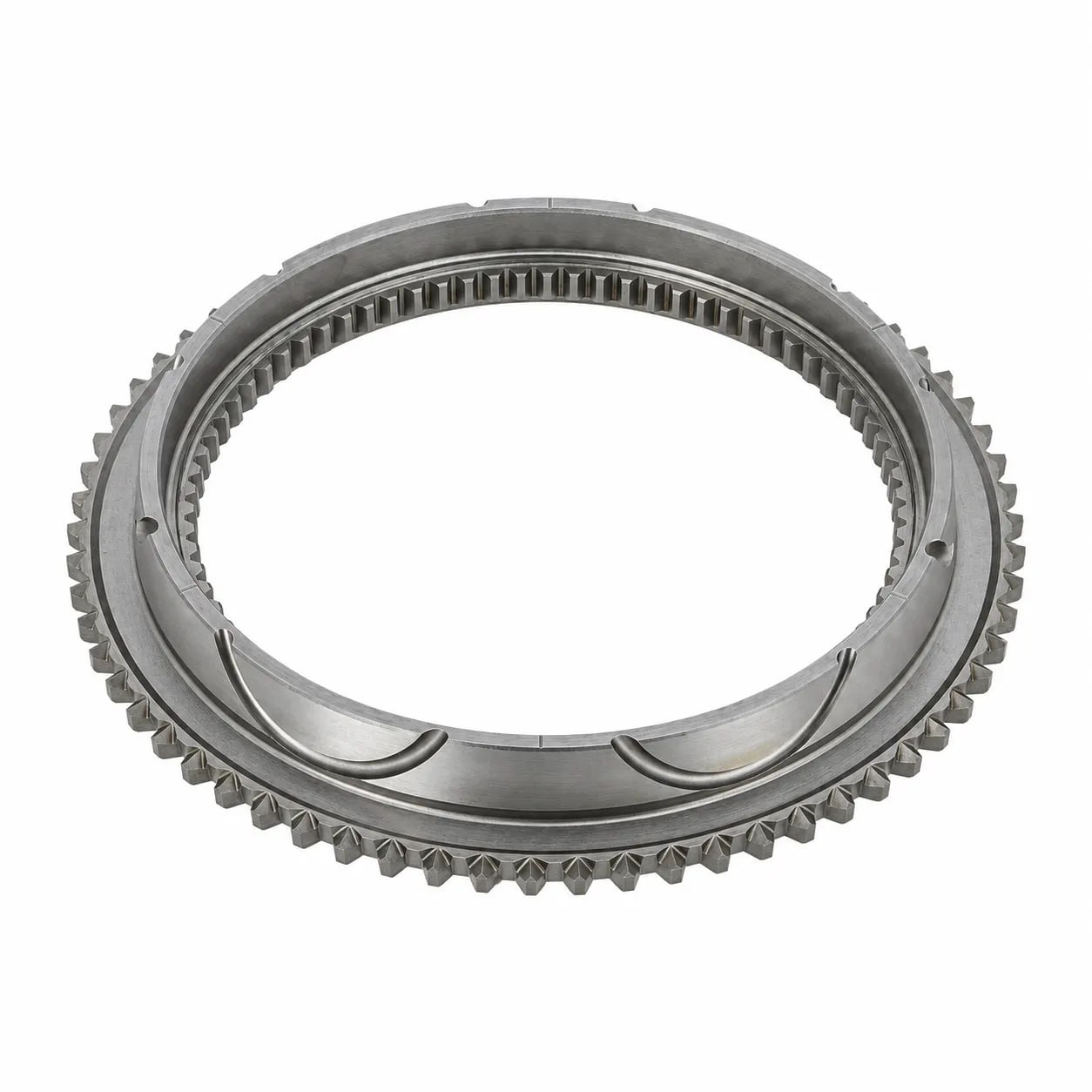
Short answer: synchronizer rings, cones, hubs and sleeves are a matched system, not four independent parts. The ring contacts the cone, the sleeve slides over the hub, and the engagement teeth decide how the shift feels. Replacing one worn item without checking its mating surfaces is how a gearbox comes back out.
What each part does
| Part | Function | What to check before ordering |
|---|---|---|
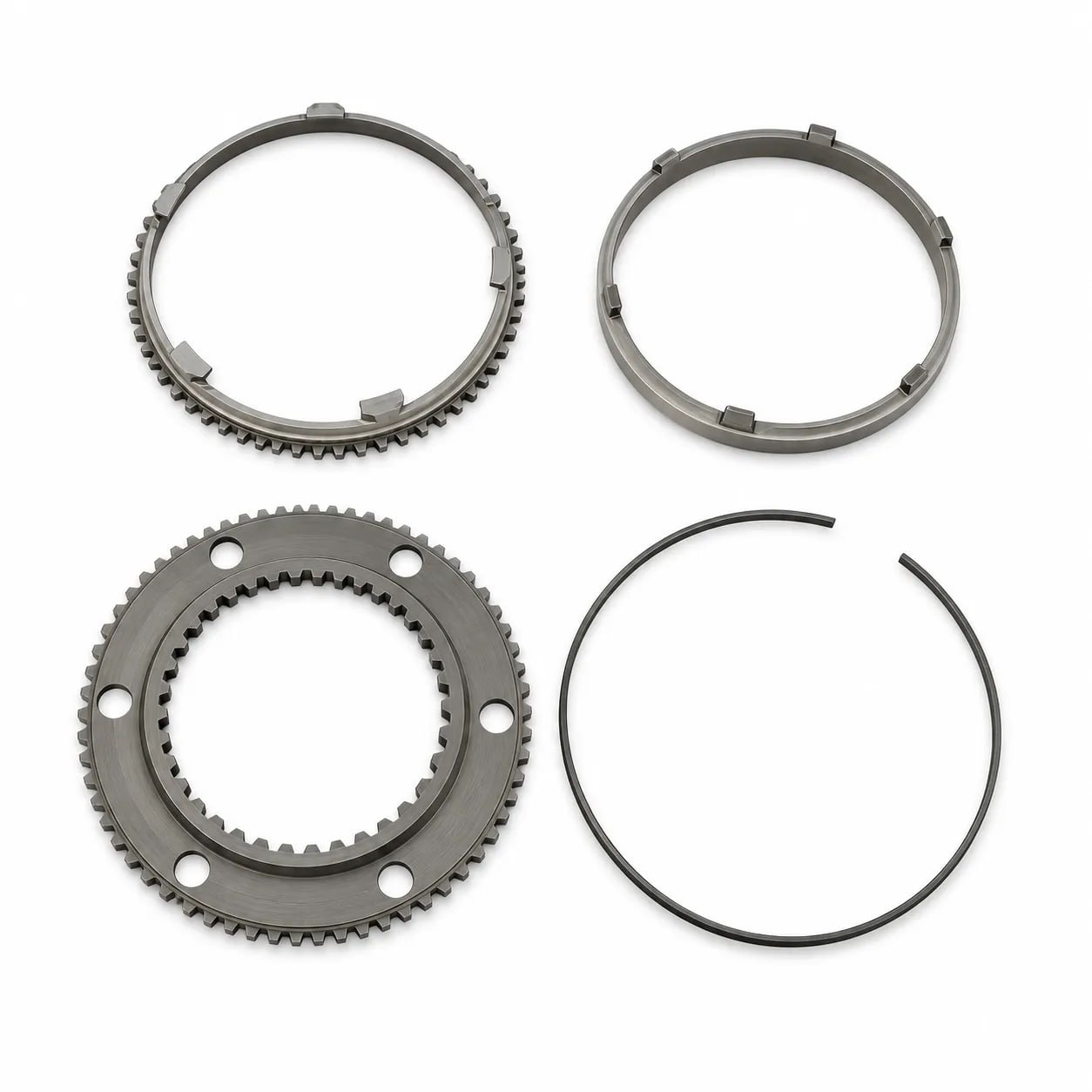
| Synchronizer ring | Provides the friction surface that brings the gear and sleeve to the same speed | Friction face condition, coating type, ring clearance and the matching cone |
| Cone | The mating friction surface on the gear or hub side | Surface wear, scoring and the angle or seat that the ring contacts |
| Hub | Carries the sleeve and locates the keys or struts on the shaft | Spline condition, key slots, cracks and the correct shaft fit |
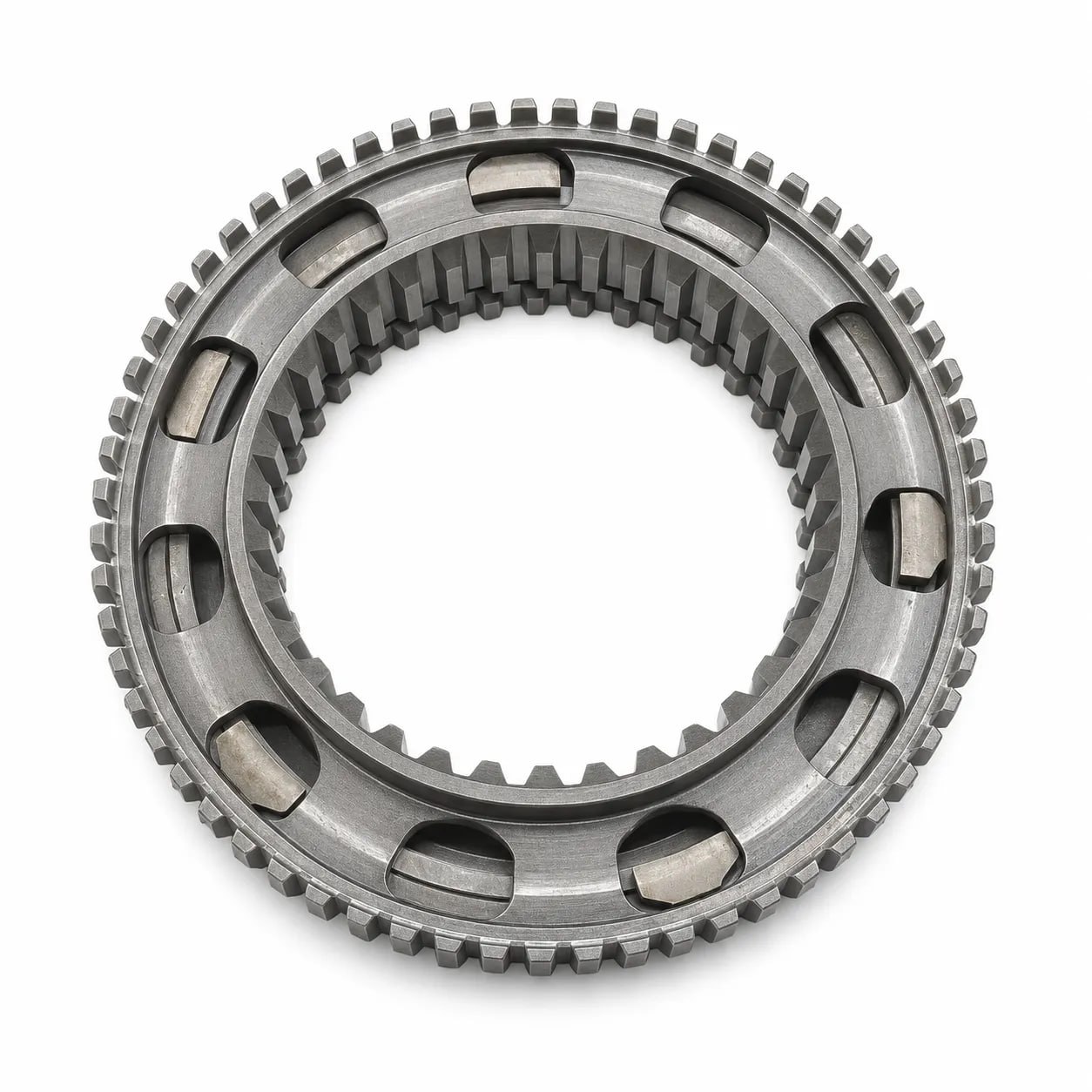
| Sliding sleeve | Moves across the hub to lock the selected gear | Engagement teeth, fork groove, wear steps and free movement |
| Keys, struts and springs | Position and preload the ring and sleeve during the shift | Completeness, spring condition and whether the kit includes them |
Why the assembly has to be treated as a system
A ring that looks serviceable can be running against a worn cone. A sleeve with good teeth can be sloppy on a worn hub. A hub can be cracked at a key slot that is hidden by the sleeve. The driver notices one symptom — grinding, a blocky shift or a gear that jumps out — but the cause can sit on either side of the contact.
For a buyer, the practical consequence is that a quotation for “one ring” may be technically correct and commercially incomplete. The right enquiry names the assembly, the reference and the mating parts that will be inspected at the same time.
What wears, and what the driver notices
- Grinding on engagement: friction face wear, cone scoring, insufficient ring clearance or a sleeve that is not engaging cleanly.
- Jumping out of gear: sleeve teeth, fork groove wear, hub splines or a detent/spring issue — not automatically the ring.
- Heavy or blocky shifts: sleeve binding on the hub, worn keys or a fork that is not moving the sleeve squarely.
- Noise after a rebuild: a mating surface that was reused without checking, or a kit that did not include the expected small parts.
These are inspection paths, not a diagnosis. The gearbox has to come apart before anyone can confirm the wear pattern.
Identification points that matter
- Friction face. Confirm whether the ring is plain, molybdenum-sprayed or carbon-coated. The face must match the application; a plain ring is not a substitute for a coated one.
- Cone seat. Check the surface the ring contacts. Scoring, polishing or a worn step changes the friction behaviour even when the ring is new.
- Hub splines and key slots. Look for cracks, fretting and rounded teeth. The hub is often reused, so it needs to be inspected rather than assumed good.
- Sleeve engagement teeth and fork groove. Check for rounded engagement teeth, a worn groove and free movement on the hub.
- Kit completeness. If the reference is a kit, confirm whether keys, struts, springs and retainers are included. “Synchronizer kit” is not a standard contents list.
- Tooth count and variant. Where the reference controls a tooth count or a suffix, check it on the old part. Do not rely on the outside diameter alone.
Coating and suffix variants are covered in more detail in Transmission part number suffixes explained. The important point for this component family is that the suffix is part of the identity, not a price code.
Common sourcing mistakes
- Ordering the ring only. The cone, hub and sleeve are mating parts; at least inspect them before closing the enquiry.
- Mixing coated and plain rings. They may share a base number but not the same friction behaviour.
- Assuming a kit includes the small parts. Ask for the contents of the exact reference, not the category name.
- Judging from a photo alone. A photo can show a broken tooth; it cannot confirm a coating or a bearing fit.
- Using a model name as the only identifier. A transmission family can carry more than one synchronizer configuration. The assembly and reference still need to agree.
What to photograph and measure
- The complete synchronizer assembly, so the relationship between ring, cone, hub and sleeve is visible.
- The friction face of the ring, straight on and in focus.
- The cone surface and any wear step or scoring.
- The hub splines and key slots; include a close-up and a wider shot.
- The sleeve teeth and fork groove.
- The stamped reference on each part, if present.
- The transmission nameplate and the assembly model.
Measure only what the reference controls: bore, outside diameter, width, tooth count or the engagement dimension the supplier asks for. Do not substitute a measurement for a reference check; use both.
How to write the RFQ line
| Field | What to write |
|---|---|
| Assembly | Transmission model, vehicle application and nameplate details |
| Component | Ring, cone, hub, sleeve or kit — and the position if known |
| Reference | The stamped or catalogue reference, including the suffix |
| Variant | Coating, tooth count or kit contents that the reference controls |
| Quantity | Units required, and whether a repeat order is expected |
| Destination | Country and any documentation or packing requirement |
A clear RFQ lets the supplier separate what can be confirmed from what still needs a photo. That is faster than a long list of guessed numbers.
Use the synchronizer rings, cones and sleeves catalogue to locate the component family, and the sliding sleeves and shift forks page for the engagement side. For the assembly context, start from the Volvo, Eaton, ZF TraXon, Mercedes-Benz or Scania catalogue.
Rebuilding a synchronizer assembly? Send the assembly details, the references and photos of the mating surfaces. We will confirm the component set before quoting.
Bottom line
Buy the system, not the symptom. Confirm the ring, cone, hub and sleeve as a set, check the suffix and the mating surfaces, and put the assembly details in the RFQ. That is the difference between a part that arrives and a repair that lasts.